The Regional Diversity of H.F. Müller’s Sheet Music

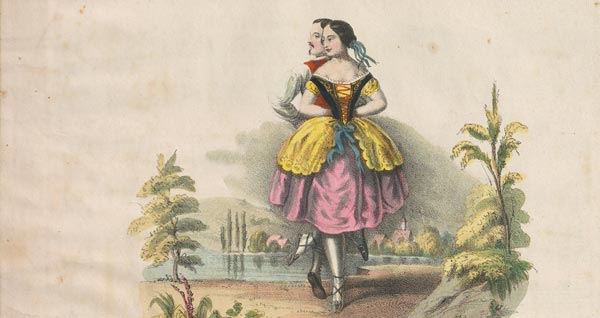
Chromolithography from Leponts La Redowa

Author: Dr. Haiganuş PREDA-SCHIMEK

Funding: Stadt Wien Kultur (Research Grant)

Duration: September 2021 — April 2022

This project illustrates the diversity of parlour music which was disseminated from Vienna through examples of the time edited by Heinrich Friedrich Müller (1843—1848) and his successors H.F. Müller’s Witwe (1848—1858) and Wessely & Büsing (1858). Thus it investigates sheet music whose titles, texts and compositional style relate to the representation of regionality or ethnicity.

The answer is sought to what sort of music in H.F. Müller’s range bore region-related titles and what did regional titles refer to. The usage of melodies of various provenance is analyzed in relation to their context of origin and to the arrangement-styles. Data has also been gathered regarding the cross-regional spread of Müller’s prints.

Thus a number of currently forgotten, but attractive music publications are being revealed and reevaluated. Ultimately, the inclusion of “regionalisms” into the novel parlour music may be interpreted as a process of “cultural translation”1. Transcribing and arranging, i.e. adjusting diverse melodies to different musical systems could be analogous to translating a cultural idiom into another, as an artistic tool for the conversion of otherness into a more comprehensible language.

Publications

Region-related Music from H.F. Müller’s Publishing House, Paper at: »Musical Networking in the ‘Long Nineteenth Century’«, 15th International Musicological and Interdisciplinary Conference of the Croatian Musicological Society, Croatian Academy of Sciences and Arts, Zagreb, Croatia, 2—5. Juni 2021.

H.F. Müller’s Cross-Regional Range: an Account of Music Printed in Vienna (1843—1858), in: Vjera Katalinić (ed.), “Musical Networking in the ‘Long Nineteenth Century’”, Zagreb: Croatian Academy of Sciences and Arts, Croatian Musicological Society (forthcoming).