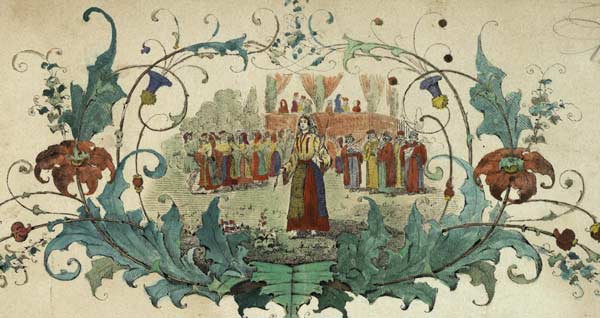
Musicians on tour in Bucharest - such as Johann Strauss the Younger or Leopold von Mayer – used popular melodies in their marketing strategy. They effectively integrated folk tunes into variations and quadrilles, melodies migrated from one work to another. Responding to the needs of the cosmopolitan salon audience, music publishers likewise perceived the sale capacity of catchwords like “national” and “exotic”.
The collection’s author was Johann Andreas Wachmann (*1807 in Pest, †1863 in Bucharest), his four notebooks appeared between 1846 and circa 1858 in H. F. Müller Verlag (after the editor’s death in 1848, in his successors’ companies H.F. Müller's Witwe and Wessely & Büsing). Wachmann chose sixty-two melodies from the minstrels’ repertoire, adapted dances to the waltz rhythm and urban tunes to modish romances; patriotic numbers without lyrics sometimes slipped in as ‘folk songs’.
In Heinrich Friedrich Müller's (*1779 in Hanover, †1848 in Vienna) publishing range, about one third of the music had regionally related titles. From the investigation of sales-related aspects (graphic design, distribution and pricing), the product quality, the editor’s far-reaching professional networks and his long experience of selling and printing art books became apparent. The folk melodies published in this way became accessible to the middle classes, in the form of high-quality notebooks that could be purchased within and beyond national borders at average prices. Vienna, as the center of sheet music printing, ball culture and piano manufacture, represented a hub in the production and distribution chain.
Seen in relation to the output of Müller’s editing company, Wachmann’s collection appears as the result of a cross-border process of cultural interaction and reception. The migration (recycling) of melodies indicate to a bourgeoning economic interest in traditional music of various provenance. Finally, a growing attention towards little known regions (southeast European, the Balkans) could be observed.